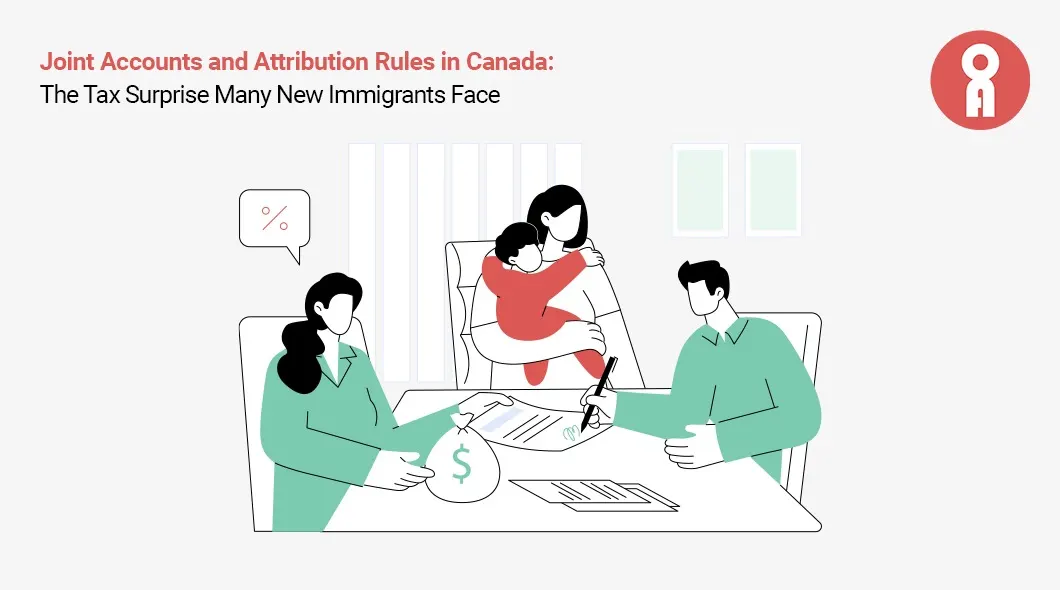


Attribution rules prevent family members from shifting income to another member in a lower tax bracket by merely transferring cash or property.
According to the Income Tax Act, any income – including interest, dividends or certain capital gains – earned from property that has been gifted or loaned by one spouse (or common-law partner) to the other is attributed back to and taxed in the hands of the transferring spouse.
The CRA enforces this through provisions such as sections 74.1 and 74.2, that have been used for decades, with relatively few changes over the years. The objective is simple: prevent income-splitting arrangements that would reduce the family’s overall tax burden.
This is usually a shock to new residents. You are considered a tax resident the moment you establish significant ties here, such as a home available for use, or a spouse or dependents residing in Canada. From that point on, you must report your worldwide income, and attribution rules apply to any transfer of funds or property between you and your spouse.
Most newcomers misunderstand this point. A joint account seems like the ideal way to share finances. The CRA does not, however, treat joint accounts as automatically equal for tax purposes. Rather, income must be reported in proportion to each person’s contribution to the account.
If you (the higher earner) deposit 80 percent of the money, you report 80 percent of the interest or dividends, even if the account is in both names. Attribution rules apply on top of this: if those funds were effectively a gift or low-interest loan from you to your spouse, the income is attributed back to your tax return regardless.
Recent surveys highlight how common this confusion is. Many newcomers report struggling with Canadian banking and tax basics, with over half finding finances harder to manage after arrival. The result? They assume the joint account automatically splits income equally and ends up with a reassessment later.
Consider a simple example:
Scenario | Contribution Split | Interest Earned | Who Reports What (Without Proper Planning) |
Higher earner deposits $10,000; spouse adds $0 | 100% from higher earner | $500 | Higher earner reports all $500 (attribution applies) |
Both contribute equally from their own earnings | 50/50 | $500 | Each reports $250 … no attribution |
Mixed funds with undocumented transfers | Blended | $500 | Higher earner may report majority due to attribution |
Keeping clear records of who put in what becomes essential. Banks often issue one tax slip under the primary account holder’s SIN, so you have to manually split the amounts when filing.
This question arises often among newcomers whose spouse or family joins them later. If your spouse remains a non-resident for part or all of the year, attribution can still apply if you (as the Canadian resident) transferred funds. Additionally, when applying for benefits like the Canada Child Benefit (CCB), you must report your non-resident spouse’s worldwide income on your return using Form CTB9.
As noted in the CRA’s guide for newcomers, tax residency is based on ties, not solely on immigration status. Many individuals assume that because both spouses have not yet arrived, their tax situation is simple – only to discover there are additional reporting requirements.

We work with hundreds of newcomers every year, who arrive eager to get started but unsure about the Canadian tax system. Our staff goes through your combined accounts, tracks the history of contributions, and files your return ensuring attribution rules are properly applied and CRA requirements are fully met.
Non-resident spouse reporting, CCB applications, foreign asset disclosure (Form T1135, required when specified foreign property exceeds $100,000 CAD in cost), and long-term planning, such as spousal loans or RRSPs, are also part of our assistance.
Whether you came last year or you are just settling down, we have made the filing easy. You will no longer need to guess at tax time. Our straightforward approach has helped clients claim every credit they are entitled to without violating CRA regulations.
Attribution rules and joint accounts are just one piece of the newcomer tax puzzle, but they can make a big difference in what stays in your pocket. By understanding how they work and getting professional help early, you can turn a potential pitfall into smart planning.
Ready to file with confidence? Contact Online Accountant today. We specialize in helping newcomers navigate Canadian taxes, so you can focus on building your life here, not worrying about the CRA.
Your first year in Canada is full of new beginnings. Make taxes one less thing to worry about.

